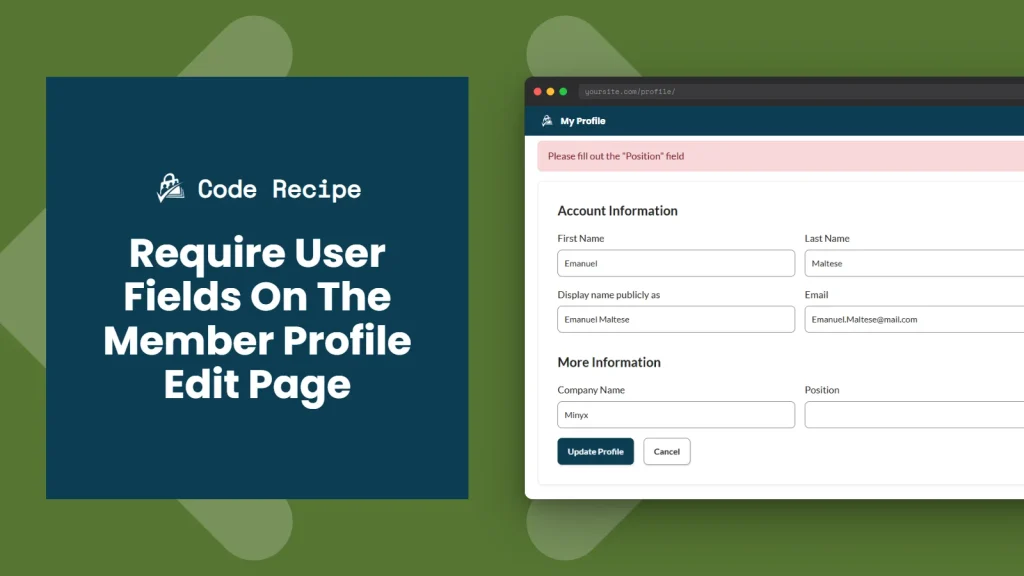
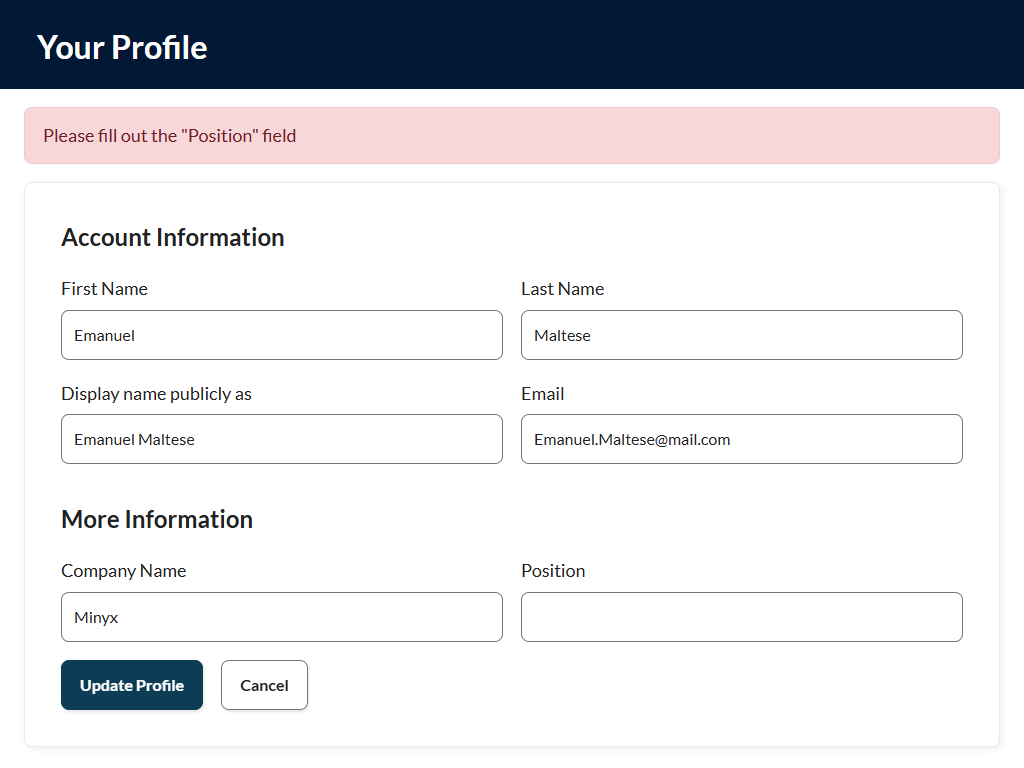
When you add user fields to your membership checkout, Paid Memberships Pro blocks the form from submitting until all required fields are filled in. When a member edits their profile page, however, PMPro allows profile saves to go through even when required fields are empty. That is by design because blocking the save would discard any other changes the member had already made to their profile.
If your site does need to block the profile form from saving to enforce required fields, then this recipe will show you how.
Do You Need This Recipe?
PMPro’s default behavior when editing the Member Profile page is intentional. Blocking the form means members lose all other changes they entered, not just the missing required field. Before adding this recipe, consider whether that trade-off fits your members’ experience.
This recipe is worth adding if:
- You collect a required field (phone number, company name, or a custom user field) that your site depends on and cannot be left blank after initial signup.
- Your member data feeds into a CRM, integration, or reporting system that breaks when the field is empty.
- Your members understand that certain fields cannot be skipped on the profile page, so strict validation will not come as a surprise.
If you would prefer not to use code, the Force Profile Completion Add On enforces required User Fields automatically and also redirects members until their profile is complete.
Best Practices and Considerations
All changes are discarded on error. When a required field is empty and an error is triggered, the entire profile save is blocked. The member’s other changes are also lost. They have to re-enter everything.
Admin-side edits are not affected. This code does not restrict profile updates made through the WordPress admin (Users > All Users > Edit). It only applies to the frontend Profile page when editing.
About the Code Recipe
The pmpro_user_profile_update_errors action fires when the member’s profile form is submitted, before any data is saved. Your callback receives three arguments:
$errors(array, passed by reference): A list of error message strings.$update(bool): Whether the operation is an update. This is alwaystrueon the member’s profile page.$user(WP_User, passed by reference): The user object being updated.
If $errors is empty when the action finishes, the profile saves normally. If it contains any strings, the save is blocked and PMPro displays each error to the member.
Both the $errors and $user parameters are passed by reference. The & in the function signature is required. Without it, changes to $errors inside your function will not carry back to PMPro’s save routine and validation will silently do nothing.
The Code Recipe
Adding the Recipe to Your Website
You can add this recipe to your site by creating a custom plugin or using the Code Snippets plugin available for free in the WordPress repository. Read this companion article for step-by-step directions on either method.
How To Customize This Code Recipe
- Require a different field. Replace the
first_namepart on line 21 with the meta key of the field you want to require. For PMPro user fields, the meta key is the Field Name set when you created the field under Memberships > Settings > User Fields. For default WordPress user fields, common meta keys includelast_name,user_email, anddisplay_name. - Customize the error message. Replace the
'Please enter a first name.'text on line 22 with the message you want to display when that field is empty. - Require multiple fields. Add an additional
if ( empty( $_REQUEST['your_field_name'] ) )block (copy lines 21-23) for each field. Update the meta key and error message for each additional field. Each missing field displays its own separate error message.

Get Support From Our Team of Experts
Have a question about how to use this feature? Our Support Page outlines three ways to get support.
Our Max plans include hands-on help customizing your membership site and implementing new features. Upgrade to PMPro Max now »