Most membership sites run on a rolling schedule. A member joins on the 12th, and their membership renews on the 12th of every month after that. But plenty of memberships work better when everyone renews together: a professional association that collects dues every January 1st, a monthly box that ships on the 1st, or a course where every student starts the same week.
Paid Memberships Pro handles all of these with settings built into each membership level. The First Recurring Payment setting controls when billing begins, and date patterns let you choose a shared date like “the next January 1st” without hard-coding a year. This guide walks through the most common shared renewal schedules and how to set up each one.
How Shared Renewal Dates Work
Every example in this guide uses the same settings on the Edit Membership Level screen. Navigate to Memberships > Settings > Levels and edit a level to find them in the Billing Details section.
- Initial Payment: Charged at checkout. This payment covers the member until the shared renewal date.
- Recurring Subscription: The billing amount and period, like $120 per year. Members pay this on every renewal.
- First Recurring Payment: When the first recurring payment is charged. Choose On a specific date to put every member on the same schedule, or After a number of days for a trial of any length.
When you choose a specific date, the date pattern builder gives you three options: The same day each month, The same date each year, or Custom pattern. PMPro works out the actual date for each member when they check out. A member who joins in March and a member who joins in October both renew on the next January 1st.
The level’s pricing text on your Levels page and at checkout shows the calculated date, so members know when their first recurring payment is coming.
Calendar-Year Membership
The most common shared schedule is a calendar-year membership that runs from January 1st to December 31st. Members can join any time during the year, pay the initial payment at checkout, and then renew with everyone else on January 1st.
- Navigate to Memberships > Settings > Levels and edit your level.
- In Billing Details, set the Initial Payment. Check the box for Recurring Subscription and set the billing amount for a period of 1 Year.
- Under First Recurring Payment, choose On a specific date. Select The same date each year and choose January 1. (As a custom pattern, this is
Y-01-01.) - Click Save Level.
A member who joins on November 4th, 2026 pays the initial payment at checkout. Their first recurring payment is on January 1st, 2027, and they renew every January 1st after that.
Calendar Year Without Automatic Renewal
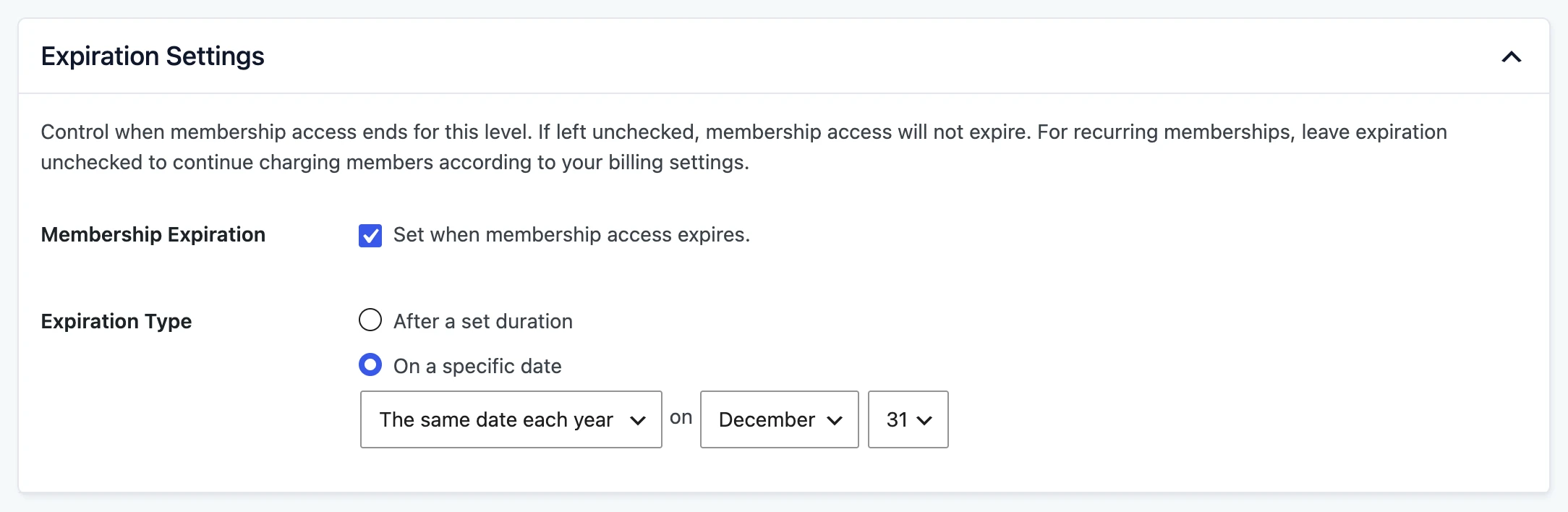
If you’d rather have members renew by hand each year, skip the recurring subscription and set an expiration date instead. In Expiration Settings, check the box for Membership Expiration and set Expiration Type to On a specific date. Then choose The same date each year and December 31. Every membership ends on the next December 31st, and members check out again to renew for the new year.
Pro Tip: The initial payment is always charged at checkout, and PMPro doesn’t prorate it. A member who joins on December 20th pays the full initial payment for 11 days of membership. If you don’t want to charge members until January 1st, set the initial payment to 0. For expiration-based levels with a lot of late-year signups, the Adjust the Set Expiration Year After a Specific Month recipe moves those members to the following year.
Membership Renews on the First of the Month
Memberships that ship a monthly box, publish a monthly issue, or run a monthly challenge often bill everyone on the 1st. Members can join any time during the month, pay the initial payment, and then renew on the 1st of the next month.
- Edit your level and go to Billing Details.
- Set the Initial Payment. Check the box for Recurring Subscription and set the billing amount for a period of 1 Month.
- Under First Recurring Payment, choose On a specific date. Select The same day each month and choose 1. (As a custom pattern, this is
Y-M-01.) - Click Save Level.
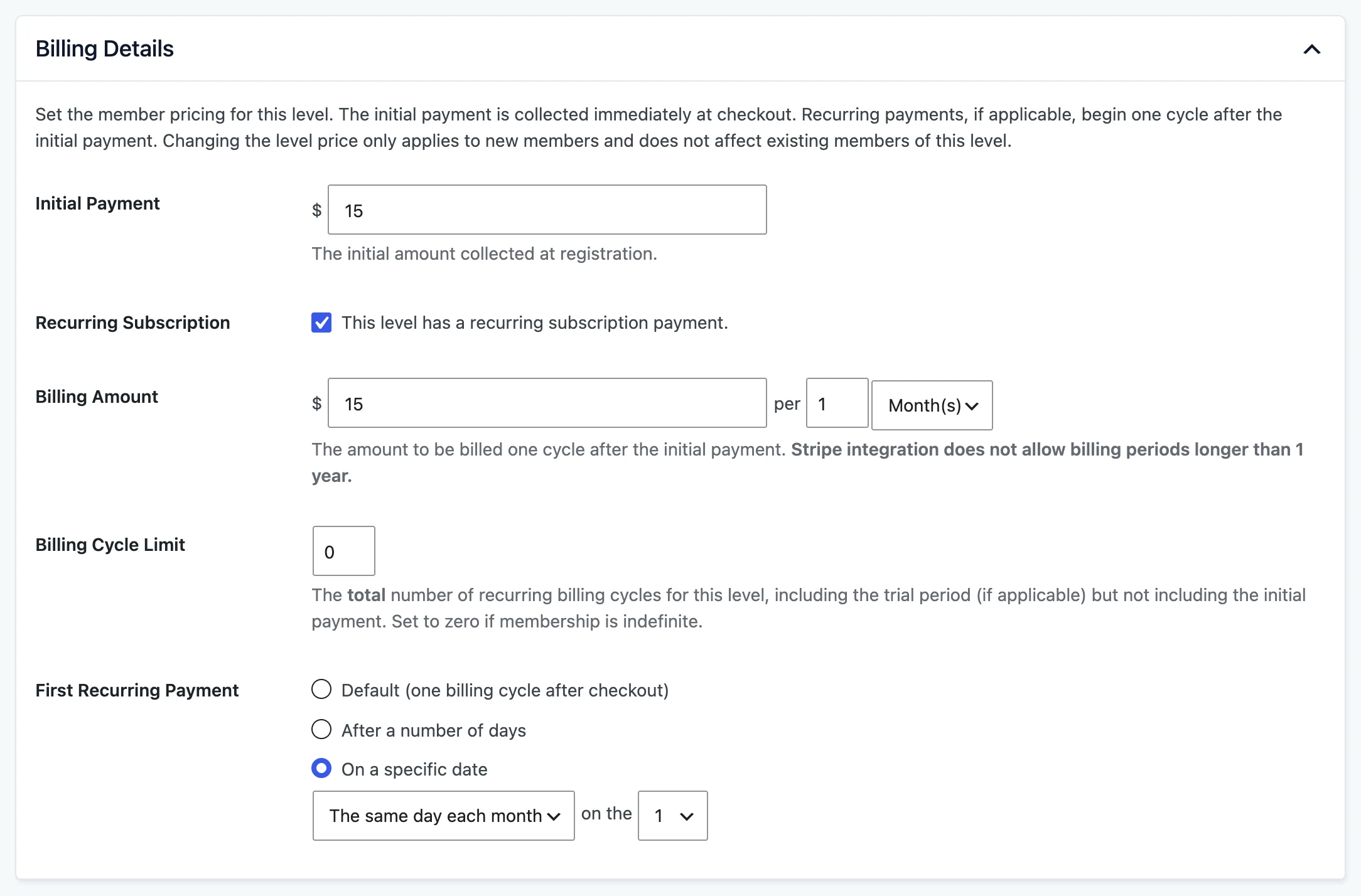
You can pick any day from 1 to 31. Day 31 means the last day of the month, so in February, members renew on the 28th (or the 29th in a leap year).
Membership Starts on a Specific Date
If you’re running a course or group program that kicks off on one specific day, you can start every member’s subscription on that date. Members sign up any time before the start, pay a deposit (or nothing) at checkout, and their recurring billing begins on the start date.
- Edit your level and go to Billing Details.
- Set the Initial Payment to your deposit amount, or 0. Check the box for Recurring Subscription and set the billing amount and period.
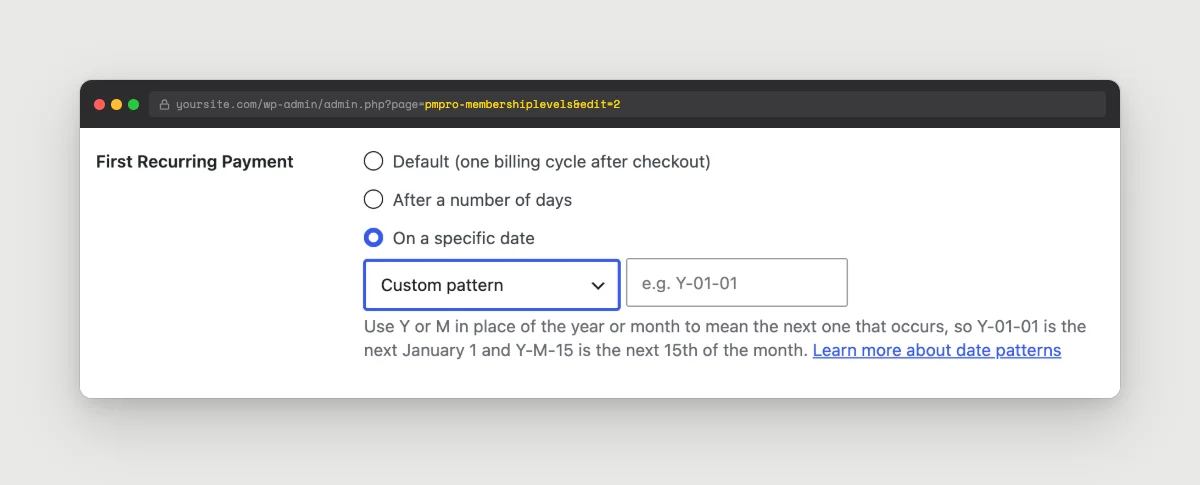
- Under First Recurring Payment, choose On a specific date, then select Custom pattern.
- Enter the start date in year-month-day format. For example, enter
2027-01-15for January 15th, 2027. - Click Save Level.
For a full walkthrough of selling a program in groups, read Building a Cohort Membership in WordPress.
Pro Tip: A fixed date doesn’t roll forward once it passes. For anyone who checks out after the start date, billing starts on the day they check out. When enrollment closes, edit the level and check the box for Disable New Signups, or update the date before you open the next cohort.
Offer a Trial of Any Length
The same setting handles trials. A level’s Custom Trial setting counts in billing cycles, so a monthly level’s trial lasts at least a month. With After a number of days, you choose the exact length.
- For a 14-day trial on a monthly level, set First Recurring Payment to After a number of days and enter
14. - For a 30-day trial on an annual level, enter
30.
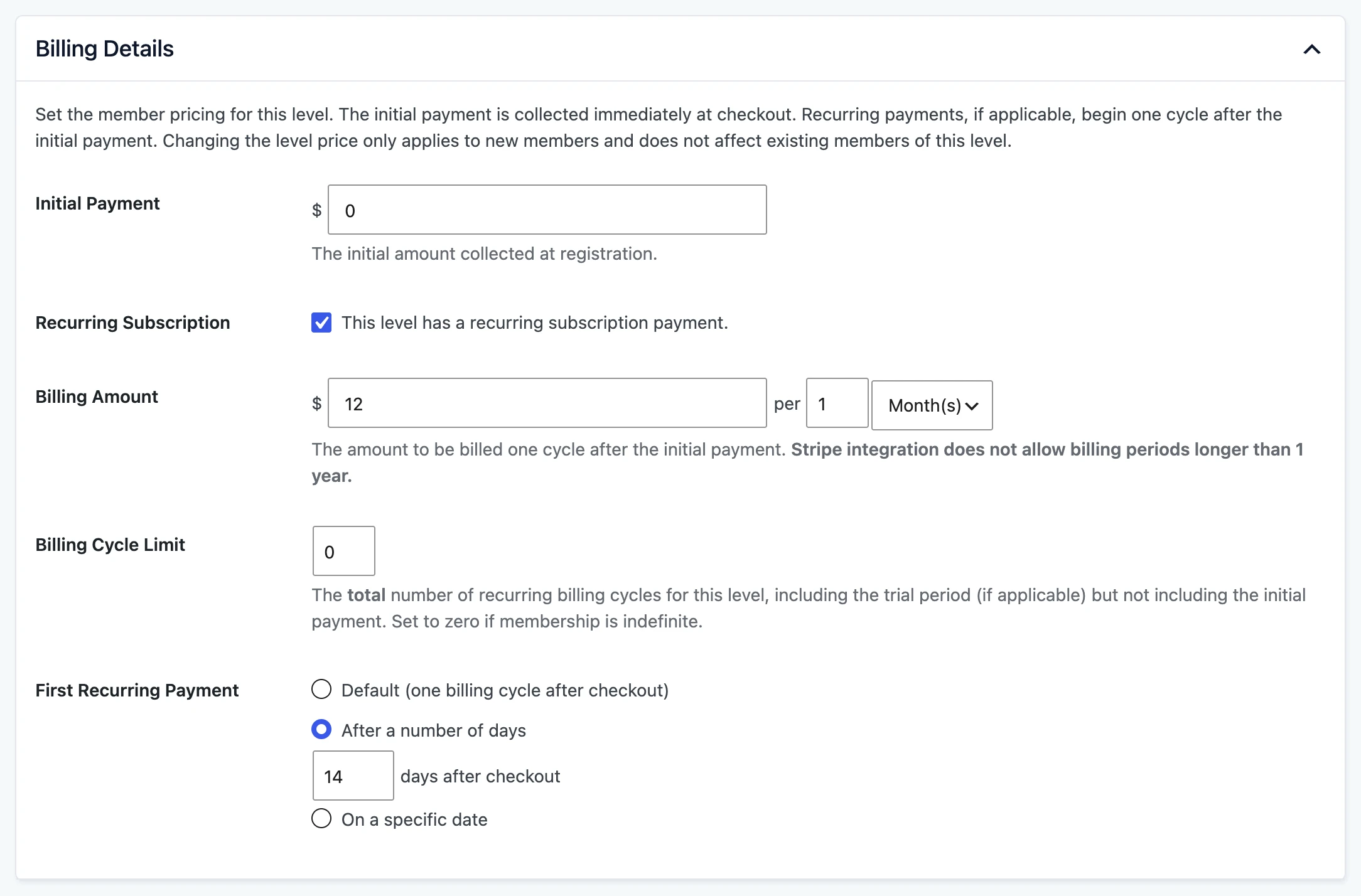
Pro Tip: To offer a free trial that still collects payment details, set the initial payment to 0. Members enter their card at checkout and aren’t charged until the trial ends. The level’s pricing text tells them when: “Your first subscription payment will be 14 days after checkout.”
Before You Switch to a Shared Renewal Date
A shared renewal date changes how billing works for the whole level. Keep these in mind before you save.
- Existing Members Don’t Move: These settings apply when a member checks out. Changing a level’s First Recurring Payment later doesn’t change the billing dates of members who already joined. Read how to update existing members after a pricing change if you need to move current subscriptions.
- Custom Pricing Discount Codes Have Their Own Dates: Percentage and fixed amount discount codes use the level’s setting. A code set to “Set custom pricing per level” has its own First Recurring Payment setting and doesn’t fall back to the level’s, so set the date on the code too.
- Renewal Day Is Busy on Large Sites: When every member renews on the same day, your payment gateway sends your site a notification for each payment at the same time. If you have thousands of recurring members, check with your host about the extra load.
- Older Patterns Still Work: Patterns written for the Subscription Delays Add On, like
Y1-M2-01, keep working and show in the builder as a custom pattern.
Start with one level and check its pricing text on your Levels page to confirm the date PMPro calculates. For every pattern option and the rules PMPro follows, read the Date Patterns documentation.
Related Reading