If you are trying to figure out what to charge for your membership, you probably want this post to give you a number. It will not, at least not directly. “What should I charge?” is the wrong question to ask first.
Pricing is a sequence of decisions, and each one makes the next one easier. The price point itself is the last decision in the sequence, not the first. This post walks through the seven decisions in the order that makes the work easier. Each one has a confident answer for most membership sites and a deep-dive linked for the readers who want more.
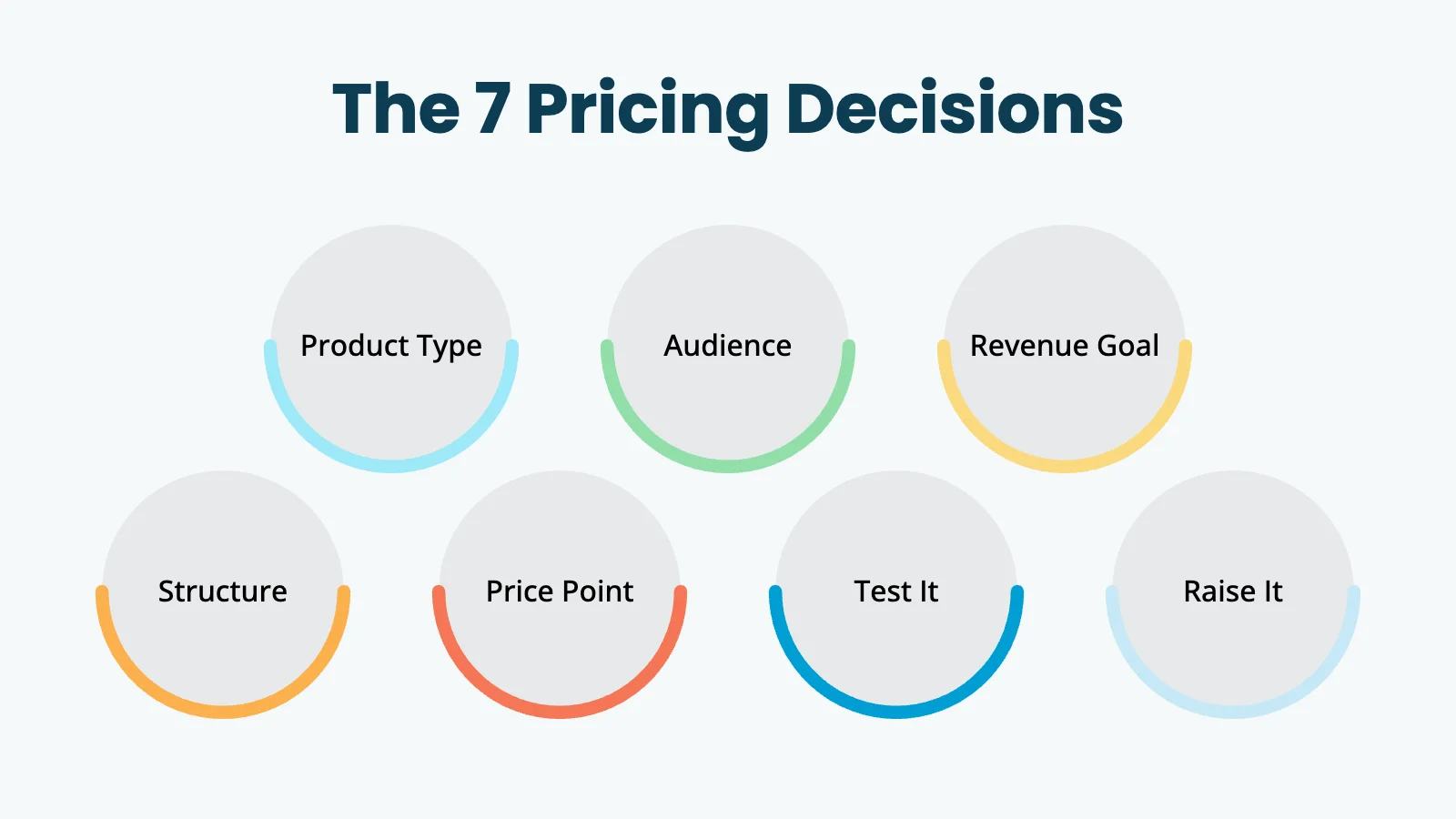
The seven decisions are: what kind of product are you, who is it for, how much do you want to make, what is the pricing structure, what is the price point, how will you test it, and when do you change it. We will walk them in that order.
Table of contents
- Four Rules to Set Before Any of the Decisions
- Decision 1: What Kind of Product Are You?
- Decision 2: Who Is It For?
- Decision 3: How Much Do You Want to Make?
- Decision 4: What Is the Pricing Structure?
- Decision 5: The Price Point Itself
- Decision 6: How Will You Test the Price?
- Decision 7: When and How to Change It
- A Closing Word: Most Founders Charge Too Little
- Ready to Configure Your Levels?
Four Rules to Set Before Any of the Decisions
Four ground rules apply to every decision below. Keep them in mind as you work through the rest of the post.
- Sell already: Do not let pricing anxiety delay launching. You learn more about pricing in the first month of selling than in six months of thinking about it.
- Trust your instinct: If $30 per month feels right and $300 per month feels wrong, your intuition is using real information. Do not override it with a spreadsheet unless the spreadsheet has a specific reason to.
- Keep it simple at the start: Complex pricing schemes (multiple tiers, extra-fee modules, usage-based components) are easier to add later than to remove. Launch with the simplest version that works.
- You can change your price: Almost no pricing decision is irreversible. Make a call, ship it, learn from the response, and adjust.
These four rules support every decision below. The decisions are guidelines. They are a sequence of questions that, answered honestly, point you at an ideal price.
Decision 1: What Kind of Product Are You?
This is the first decision because everything downstream depends on it. Membership sites cluster into a few broad shapes, and they price differently.
- Content libraries: Your value is access to a body of content (articles, videos, courses, downloads). Members pay for ongoing access. Price tends to be modest per month.
- Communities: Your value is access to other members. The people are the product. Pricing can be higher because the value compounds with member count, but acquisition and retention are both about people, not content.
- Software or tools: Your value is functional. Software, calculators, templates, services that do something specific. Pricing aligns with similar SaaS products in your category.
- Service or coaching: Your value is direct interaction with you or your team. Pricing is typically much higher because supply is bounded by human time.
Most membership sites are some hybrid. Content plus community is the most common. The exercise is to identify the primary value proposition: the thing a member would say first if asked “why do you pay for this?”
One useful test: Imagine your most engaged member describing your membership to a friend. What is the first sentence? “It is where I learn X” (content). “It is where I talk to other people doing Y” (community). “It is the tool I use to Z” (software). “I work directly with [name] on W” (service). The first sentence tells you which product type you are.
Decision 2: Who Is It For?
The same content sold to two different audiences should be priced differently. A productivity course for solopreneurs and the same course for Fortune 500 employees are not priced the same way, even though the content is identical. The audiences have different willingness to pay, different alternatives, and different purchase decision processes.
Three audience comparisons that move pricing:
- B2B versus B2C: Businesses pay more than individuals for equivalent value, because businesses get reimbursed and individuals pay out of pocket. If your members are buying for their job, you can charge more than if they are buying for themselves.
- Hobbyist versus professional: A professional using your membership to do their work pays more than a hobbyist using it for fun. The professional gets a return on their investment. The hobbyist gets enjoyment.
- Wealthy versus budget-conscious: Obvious, but underused. Markets can be classified by income. Your pricing should reflect where your members sit financially.
You cannot change who your audience is just to charge more. But identifying who they actually are tells you the realistic price ceiling and floor for your market.
Decision 3: How Much Do You Want to Make?
This exercise surfaces whether your pricing strategy and your revenue goal are compatible. The math is simple:
Revenue goal ÷ price = number of members you need.
Pick a revenue goal that is honest. One that covers your expenses and is worth your time. Then look at what different price points imply about how many members you would need to reach it.
Here is what a $120,000 annual revenue target looks like at four different price points:
| Members | Price | Question |
|---|---|---|
| 1,000 | $10/month | Can you find and convert 1,000 paying members? |
| 200 | $50/month | Common price for memberships members use every month. |
| 2,000 | $60/year | Annual pricing for memberships with lower engagement. |
| 240 | $500/year | What does a $500 per year membership look like versus $60 per year? |
The point is not to use these numbers as your target. The point is to see whether the price-and-member-count combination you are imagining is realistic for your market and your audience.
A common failure point: A founder picks a low price assuming high volume will compensate, then discovers they cannot reach the volume needed. A high-price, low-volume membership is often easier to build than the inverse, especially in B2B and professional audiences. Run the math on a few combinations before you commit to one.
Decision 4: What Is the Pricing Structure?
Pricing structure is separate from price point. It is the shape of what you charge. Pick the structure before you pick the number.
The main structures worth considering:
- Single recurring tier (monthly or annual): The default. Simplest to launch and easiest to operate. Most membership sites should start here.
- Tiered pricing (for example, Basic, Pro, Premium): Works when members have genuinely different needs and you can offer differentiated value across tiers. Tempting to overdo. Three tiers is usually the right ceiling.
- Front-loaded pricing: Charge more upfront with an initial payment, then a smaller recurring fee. Reduces churn anxiety, can double first-year revenue per member, and works especially well for memberships with high onboarding value. Paid Memberships Pro is built for this.
- Free trial: Lets prospects try before they pay. Works for content and software memberships. Tricky for community memberships, where the value depends on commitment.
- Lifetime or one-time pricing: Tempting for cash flow. Usually a mistake. Recurring revenue is what makes a membership business valuable over time. Avoid unless you have a specific reason.
For the full menu of structures and trade-offs, see 10 Popular Pricing Models for Membership Sites.
The decision: Pick the simplest structure that fits your product type and audience. Add complexity only when you have evidence it is needed. Once you have picked your structure, the Membership Levels documentation walks through how to configure it in Paid Memberships Pro.
Decision 5: The Price Point Itself
By now you know your product type, your audience, your revenue goal, and your structure. The price point is the final number you put on that structure. Two exercises can help you triangulate it.
Exercise One: Time and Materials × Margin
Calculate what it costs you to acquire and serve a member. Include payment processing fees (typically 3% to 5%), sales tax (varies), platform fees, support costs, advertising, content production, and anything else you spend to keep one member happy for a month. That is your unit cost. Then multiply by 2, 3, or 4 for margin.
The result is your price floor. The minimum you need to charge to be profitable. If your floor is higher than what the market will bear, you have a business model problem, not a pricing problem.
Exercise Two: Value to Your Customers
What does your membership help your customers save or earn? Put a dollar number on it. If your membership saves a professional five hours a month and their time is worth $100 an hour, the membership is worth $500 a month to them. They will not pay that. They will pay a fraction. That fraction is your ceiling. Most pricing happens between 5% and 25% of the value delivered.
If your floor (cost × margin) is higher than your ceiling (value × pricing fraction), you have a problem. Most of the time, the price you should charge sits comfortably between them. The choice within that range is partly instinct, partly market research, and partly experimentation.
A useful sanity check: If you are charging less than $20 per month and your members get real ongoing value, you are probably charging too little. The “$5 to $10 per month” reflex for membership pricing is a holdover from a decade ago, when audiences expected lower digital prices. Audiences have adjusted. Charge for the value.
Decision 6: How Will You Test the Price?
This is the section most pricing guides skip, and it is the most important one. Your first price is a hypothesis, not a commitment. The way to find the right price is to ship one and watch what happens.
What “watching” looks like:
- Conversion rate: What percentage of visitors to your pricing page become paying members? If it is far below industry benchmarks for your category, your price is probably too high for the value you are communicating. Note: “too high for the value you are communicating” is sometimes a value-communication problem, not a price problem. Try making the value clearer before lowering the price.
- Churn rate: What percentage of members cancel each month? The average membership-based site sees a 6.7% annual churn rate, so use that as a rough benchmark, not a target. High early churn often signals “I bought this and it was not worth the price.” Low churn with low engagement signals “I am getting some value but not a lot, and I will cancel eventually.”
- Member feedback at cancellation: Cancellation surveys are gold. Members tell you why they are leaving. If price comes up repeatedly, that is a signal. If price does not come up at all, the issue is elsewhere. Use our Reason for Cancelling Add On to understand why members are leaving
- What happens when you change the price: Run a price experiment occasionally. Raise it 20% for new signups and watch conversion. Lower it 10% and watch. The data tells you whether you are in the right range.
Three months is the minimum useful observation window because monthly recurring data needs several cycles to be meaningful. Do not change pricing every two weeks. You will be reading noise, not signal.
Decision 7: When and How to Change It
You will, eventually, change your pricing. New customers should pay more than your earliest customers did, because your membership is worth more now than it was at launch. You have more content, a bigger community, and more reputation. The question is not whether to raise prices but when and how.
When to Raise
- Your content library or value has grown materially.
- Your costs have grown.
- Your testing data suggests you have room to.
- You are consistently the cheap option in your category and you do not want to be.
- Inflation has eaten into your real revenue and you have not raised in a year or two. If your costs are up 15% and your pricing is flat, you have taken a 15% pay cut without noticing. Adjust accordingly.
How to Raise: The Strategic Side
- Communicate honestly and in advance.
- Consider grandfathering existing members at their current price.
- Lean into value, not justification.
How to Raise: The Technical Side
In Paid Memberships Pro, raising prices in the membership level settings only affects new checkouts. Existing subscriptions will continue to bill the old amount.
Related: How to Update Existing Members
The combined strategic and technical understanding is what makes a price change land well. Skip the mechanics and you get “wait, why am I still being billed the old amount?” support tickets. Skip the strategy and you get members who feel blindsided instead of informed. Handle both and the change barely registers as news.
A Closing Word: Most Founders Charge Too Little
If you have worked through the decisions above honestly and arrived at a price, here is a final aspect to consider. In our experience working with thousands of membership site owners, the most common pricing mistake is charging too little, not too much.
Founders undercharge for three reasons. They are afraid of losing customers to price (real, but usually overblown). They undervalue their own work (real, but fixable). They look at the cheapest competitor and assume that is the market price (the cheapest competitor is usually the cheapest for a reason, and they are not your model).
If your pricing instinct is making you uncomfortable because it feels high, that’s usually a signal you’re in the right place, not a reason to back off. Run the exercises, trust the data, and ship the price. You’ll learn more from how real members respond than from another week of analysis.
Ready to Configure Your Levels?
When you have answered the seven decisions and have a price you are ready to test, the next step is putting it into your site. The Membership Levels documentation walks through how to configure pricing, billing periods, trial periods, and expiration in Paid Memberships Pro.
And if you would rather talk through your specific pricing decision with other operators who have made the same calls, the Paid Memberships Pro community Slack is where those conversations happen. Pricing is one of the most-discussed topics in the channel, and you will not be the first person to ask.

Free Download: The AI-Powered Membership Site Blueprint
Download the free guide: Learn how to plan, build, and grow a membership site using AI as your strategic partner: from buyer persona to launch and beyond.