“What kind of business insurance covers a membership site?” A coach in our Slack community asked that recently, along with a follow-up: what coverage language should she be looking for?
We hear versions of this question a lot, especially from people at the beginning of their business journey. The membership software is the easy part. The procedural questions around LLCs, taxes, contracts, and insurance are where new owners get stuck, because nobody hands you a checklist.
Insurers cover business activities, not websites. There are insurance packages built for coaches, consultants, and course creators (we list some below), but there is no product called “membership site insurance,” and the membership plugin is never what gets insured. A coaching membership, a paid newsletter, a nonprofit association, and an online course library all run on the same software and carry very different risks. The job is to describe what your business does and confirm the policy language covers those activities.
This post walks through the four types of coverage that come up most often for online businesses, what each one protects against in a membership context, the bundled packages that exist for coaches and creators, what other owners report paying, and the specific policy language to ask about. We focus on coaching and services memberships because that is where the question came from, then cover how the mix changes for other kinds of sites.
Table of contents
- How an Insurance Broker Sees Your Membership Site
- The Four Coverage Types Most Online Businesses Consider
- What a Coaching or Services Membership Usually Needs
- Is there a bundled package for coaches and creators?
- Policy Language to Look For
- How the Mix Changes for Other Types of Membership Sites
- What Insurance Will Cost
- What Other Owners Report Paying
- What to Do Before You Call a Broker
- Frequently Asked Questions
- Related Reading
How an Insurance Broker Sees Your Membership Site
When you tell a broker you run a membership site, they hear a delivery method, not a business. The site is how you deliver and charge for your work. The policy needs to cover the work itself, so a good broker will ask what members are paying you for and where that could go wrong.
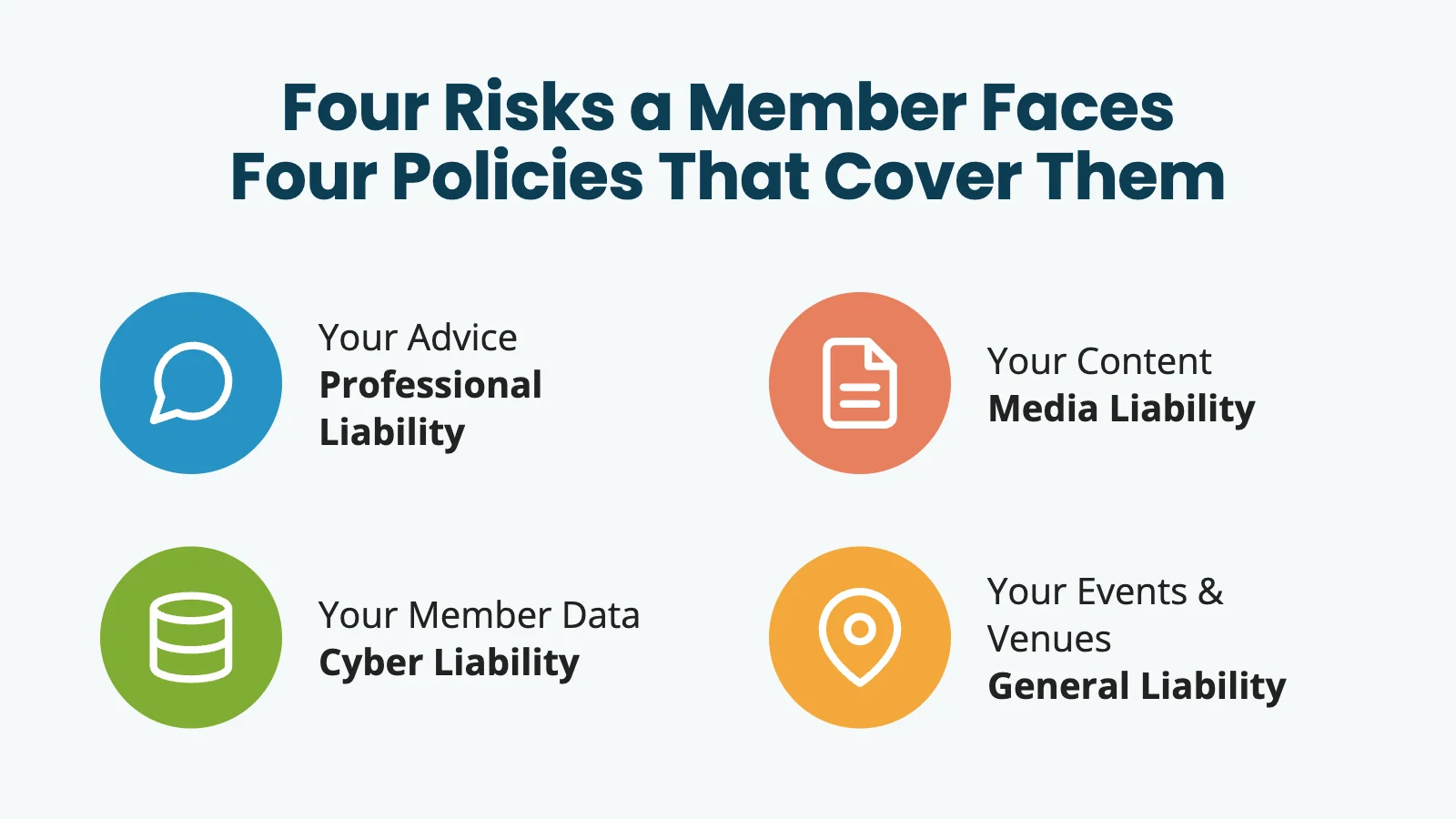
Think about what a member can actually be harmed by:
- Your advice: A coaching client follows your framework, makes a decision, and loses money or a job.
- Your content: A blog post or course video quotes someone unfairly, uses an image you did not license, or borrows a little too heavily from someone else’s work.
- Your data: Your WordPress site stores names, email addresses, and billing history for every member who has ever checked out.
- Your physical presence: You host a live retreat or workshop and someone trips on a cable.
Each of those is a different line of coverage. A membership site owner might need one of them, or all four, depending on what the members are paying for. That is the conversation to have with a broker.
The Four Coverage Types Most Online Businesses Consider
Each policy type covers a different way a member can be harmed. This is how each one applies when your customers are members.
Professional Liability (Errors and Omissions)
Professional liability insurance, also called Errors and Omissions or E&O, covers claims that your professional service caused someone financial harm. For a coach or consultant, this is the big one. If a member says your advice was negligent, incomplete, or failed to deliver what you promised, this is the policy that pays for the defense and any settlement.
General liability does not cover this. Many first-time business owners buy a general liability policy, assume they are protected, and find out otherwise when a former client sends a demand letter.
A few things to know about E&O policies:
- They are almost always claims-made policies, which means the policy has to be active both when the incident happened and when the claim is filed. If you let coverage lapse, you can lose protection for work you did years ago.
- They come with a retroactive date. Anything you did before that date is not covered. Ask for the earliest retroactive date you can get, ideally the date you started offering services.
- They define “professional services” narrowly, and that definition is where most coverage gaps hide. More on that below.
Cyber Liability
Cyber liability covers the costs of a data breach or security incident. Every membership site collects personal data at checkout. Even if your payment gateway handles the card numbers (which it should), your WordPress database still holds names, emails, addresses, and order history.
A typical cyber policy covers two kinds of costs:
- First-party costs are what you spend cleaning up your own mess. Forensic investigation, legal counsel, notifying affected members, credit monitoring, and restoring your site from backup.
- Third-party costs are claims from other people. A member sues because their data leaked, or a regulator fines you for failing to notify people in time.
Two details matter for membership sites. First, check whether the policy covers social engineering and funds transfer fraud. That is the phishing email that tricks you into changing the bank account your gateway pays out to. It is often a separate sublimit or excluded entirely. Second, expect the insurer to ask about your security practices. Two-factor authentication on your admin accounts, tested backups, and keeping WordPress and plugins updated are usually requirements, and a claim can be denied if you said you had them and did not.
Media Liability
Media liability covers claims arising from content you publish. Defamation, copyright infringement, trademark infringement, plagiarism, and invasion of privacy. If your membership includes a blog, a podcast, a video library, or a newsletter, you are a publisher, and this is the coverage for publishers.
General liability policies include a small amount of “personal and advertising injury” coverage that sounds similar, but it is usually limited to your advertising and often excludes businesses whose main product is content. Do not rely on it to cover your course library.
If members can post in a forum or comment section, ask specifically about user-generated content. Many media policies exclude it or cap it at a low sublimit. A community site with an active discussion board carries a different exposure than a coach who publishes a weekly article.
General Liability
General liability covers bodily injury and property damage to third parties. If your business is 100% online and you never meet a member in person, this is the least urgent policy on the list.
You will probably still want it. Venues require a certificate of general liability before they let you host a workshop. Some corporate clients require it before they sign a contract. And if you ever bring in a contractor or meet a client at a coworking space, the exposure is real. It is also the cheapest of the four, so it is usually not the place to economize.
Many small businesses buy general liability bundled with commercial property coverage as a Business Owner’s Policy (BOP). A BOP is fine, but note what it leaves out: professional liability, cyber, and media coverage are all separate purchases unless you add them.
What a Coaching or Services Membership Usually Needs
If your membership site sells access to you (group coaching calls, one-on-one sessions, office hours, a private community where you answer questions, templates and frameworks you created), your risk profile looks like this:
| Coverage | Priority for a coaching membership | Why |
|---|---|---|
| Professional liability (E&O) | Highest | Your advice is the product. This is the claim most likely to happen. |
| Cyber liability | High | You hold member data and take recurring payments. |
| Media liability | Medium | Depends on how much you publish and whether members post. |
| General liability | Lower, but cheap | Needed for events, venues, and some client contracts. |
The order flips for other business types, which we cover below. For a coach, professional liability is the one you should not launch without.
A few coaching-specific notes:
- Use a coaching-specific policy if one is available: Generic “consultant” E&O forms sometimes exclude coaching-style advice, or exclude anything that sounds like health, wellness, or mental health. If you coach in those areas, say so explicitly on the application.
- Marketing promises create exposure: “Double your revenue in 90 days” is a guarantee, and guaranteed-results claims are commonly excluded from E&O coverage. Your sales page and your policy need to agree with each other.
- Guest experts and subcontractors should carry their own coverage, and your policy should cover your liability for their work on your platform.
Is there a bundled package for coaches and creators?
Yes, with a caveat. Several insurers sell occupation-based packages that combine general liability and professional liability in one purchase, and a few of them are written specifically for coaches and online educators. The three below are examples to compare, not endorsements. We are not affiliated with any of them.
- Insurance Canopy sells a life coach and career coach policy that bundles general liability and professional liability at $1 million per occurrence and $2 million aggregate. Their published price starts at $229 per year, with a cyber rider and a higher $3 million aggregate limit available as add-ons. They also publish that most of their customers pay between $26 and $30 per month, and that about 65% of their career coach policyholders earn under $50,000 a year from coaching.
- Hiscox has a dedicated online coaching insurance product in the UK that lets you combine professional indemnity (the UK term for E&O), cyber and data, and public liability. In the US, Hiscox sells professional liability and general liability to life and career coaches as separate policies you can pair.
- NEXT Insurance (now ERGO NEXT) sells life coach insurance as a set of policies (professional liability, general liability, and optional commercial property or cyber) with a discount for bundling two or more.
The caveat is that these are built around the profession, not the website. A coaching bundle assumes you coach. If your membership also includes a course library, a member forum, or a podcast, read the professional services definition and ask whether media liability and user-generated content are covered or need an endorsement. The bundle is a good starting point and often the cheapest one. It is not automatically the whole picture.
Coaching associations also run affinity programs. If you belong to one, ask what they offer before shopping on your own.
Policy Language to Look For
This is the part the original question was about. When a broker sends you a quote or a sample policy, read these parts closely.
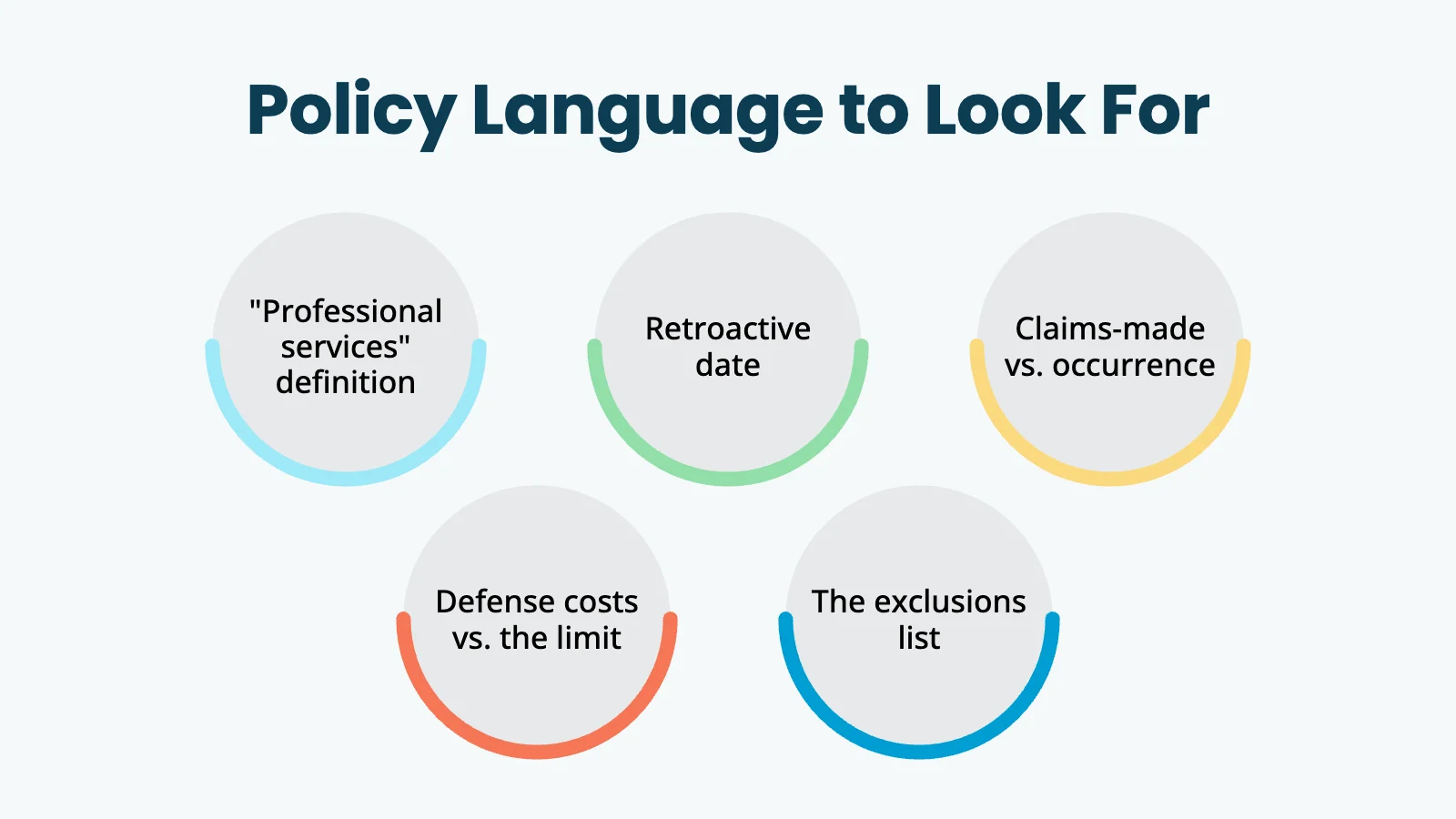
The definition of “professional services.” This is the single most important sentence in an E&O policy. It should describe what you actually do: coaching, consulting, training, group facilitation, creating and selling online courses, operating a membership community. If your work is not in the definition, it is not covered. Broad wording like “services you provide for a fee” is better than a narrow list.
Retroactive date. Earlier is better. If you are switching carriers, make sure the new policy honors your old retroactive date. Otherwise you lose coverage for everything before the switch.
Claims-made vs. occurrence. E&O, cyber, and media policies are usually claims-made. General liability is usually occurrence-based, which means it covers incidents that happen during the policy period regardless of when the claim is filed. Understand which you have so you know what a lapse would cost you.
Extended reporting period (tail coverage). If you close the business or retire, tail coverage lets you report claims after the policy ends. Ask what it costs and how long you have to buy it.
Defense costs inside or outside the limit. A $1 million policy where legal fees count against the $1 million is worth less than one where defense costs are paid separately. Legal defense in a professional liability claim can run into six figures before anyone talks about a settlement.
Exclusions. Read every one. The ones that bite membership site owners most often:
- Guaranteed or promised results
- Medical, mental health, legal, or financial advice (if you touch these areas without a license)
- Intentional acts and knowing violations of law
- Contractual liability you took on beyond what the law would impose
- User-generated content (in media policies)
- Failure to maintain the security controls you claimed on the application (in cyber policies)
Territory. Members buy from everywhere. Confirm the policy covers claims from outside your home country, or at least from wherever most of your members live.
Limits. One million per claim and two million aggregate is the common starting point in the US, and it is what most corporate clients ask for on a certificate. Higher revenue, higher-ticket programs, or a large member database all argue for more.
How the Mix Changes for Other Types of Membership Sites
Same software, different risk. The priorities shift depending on what members pay for.
Online courses. Close to coaching, with one difference: your content is doing the teaching, so media liability moves up. Licensing for music, stock footage, and images in your videos matters more. If students can post in a discussion area, ask about user-generated content.
Paid newsletters, blogs, and podcasts. You are a publisher first. Media liability leads, cyber is second because you still hold subscriber data, and E&O may not apply at all unless you also sell advice or consulting.
Communities and forums. User-generated content is your biggest exposure. Members post, and you moderate. Media liability with explicit UGC coverage is essential, and your terms of service should give you clear authority to remove content and members.
Associations and nonprofits. Membership organizations often need Directors and Officers (D&O) coverage on top of the four above, because board members can be personally named in lawsuits. Event coverage becomes a bigger deal if you run an annual conference. Many nonprofit-focused insurers bundle these.
Directories and marketplaces. If members list services and other people hire them through your site, you may have exposure for vetting or for transactions between members. This is worth a specific conversation with a broker.
Private video and downloads. Mostly a media and cyber question. Make sure the media policy covers the full library, not only new content, and that the cyber policy covers loss of the content itself if your hosting is compromised.
What Insurance Will Cost
Prices vary by state, revenue, claims history, and how much data you hold. For a solo US coach or consultant, published ranges from insurance marketplaces look roughly like this:
| Coverage | Rough annual cost (solo, US) |
|---|---|
| Professional liability (E&O) | $300 to $1,300 (coach-specific bundles with GL start around $229) |
| General liability | $230 to $400 |
| Cyber liability | $350 to $1,500 |
| All three combined | Around $900 to $2,000 |
Media liability is harder to price because fewer small businesses buy it standalone. It is sometimes available as an endorsement on an E&O or cyber policy for a few hundred dollars more.
Compared to the rest of your membership site budget, this is a modest line item. A single demand letter costs more than a decade of premiums.
These numbers come from public rate guides and are here to help you sanity-check a quote, not to replace one.
What Other Owners Report Paying
Rate guides are useful, but the most convincing numbers come from people describing what they actually bought. These examples come from owners in adjacent businesses. Prices are what each person reported at the time, in their state, for their revenue and risk profile. Yours will differ.
- A freelancer doing web and content work in South Florida (about $85,000 in annual revenue) wrote up their E&O purchase in 2025. The first quote was $1,200 per year. After shopping around with a broker, they paid $692.19 per year for $1 million per claim and $2 million aggregate with a $500 deductible. A graphic designer friend in Ohio paid $390 per year for similar coverage. Their takeaway: location moved the price more than anything else.
- A CPR instructor on Reddit (r/CPRInstructors, 2025) was quoted about $700 per year by Hiscox for general and professional liability together. Another instructor in the thread said they pay Hiscox for general liability and a professional association carrier for professional liability at $82 per year. The original poster then got a quote from that second carrier for under $400 for both. Same coverage, about half the price, because the second carrier specializes in instructors.
- Coaches in r/lifecoaching (2024 and 2025 threads) report paying around $250 per year for coaching liability with limits in the $1 million to $3 million range, and name carriers like Berxi and Insurance Canopy when asked who they use.
- Sam Vander Wielen, an attorney who works with online coaches and course creators, covered this question in an episode of her podcast titled “How Much Should Business Insurance Cost for Coaching Businesses?” Her expectation for an online coaching business is $400 to $1,000 per year for liability coverage.
The pattern across all of these: the first quote is rarely the best one, specialist carriers who already understand your profession tend to price lower than generalists, and a solo online coach or consultant with $1 million in professional liability is usually paying somewhere between a couple hundred and a thousand dollars a year.
What to Do Before You Call a Broker
No policy covers “a membership site.” Coverage follows what your business does for members, so the more clearly you can describe that, the better the policy fits. You will get better quotes and better coverage if you show up prepared.
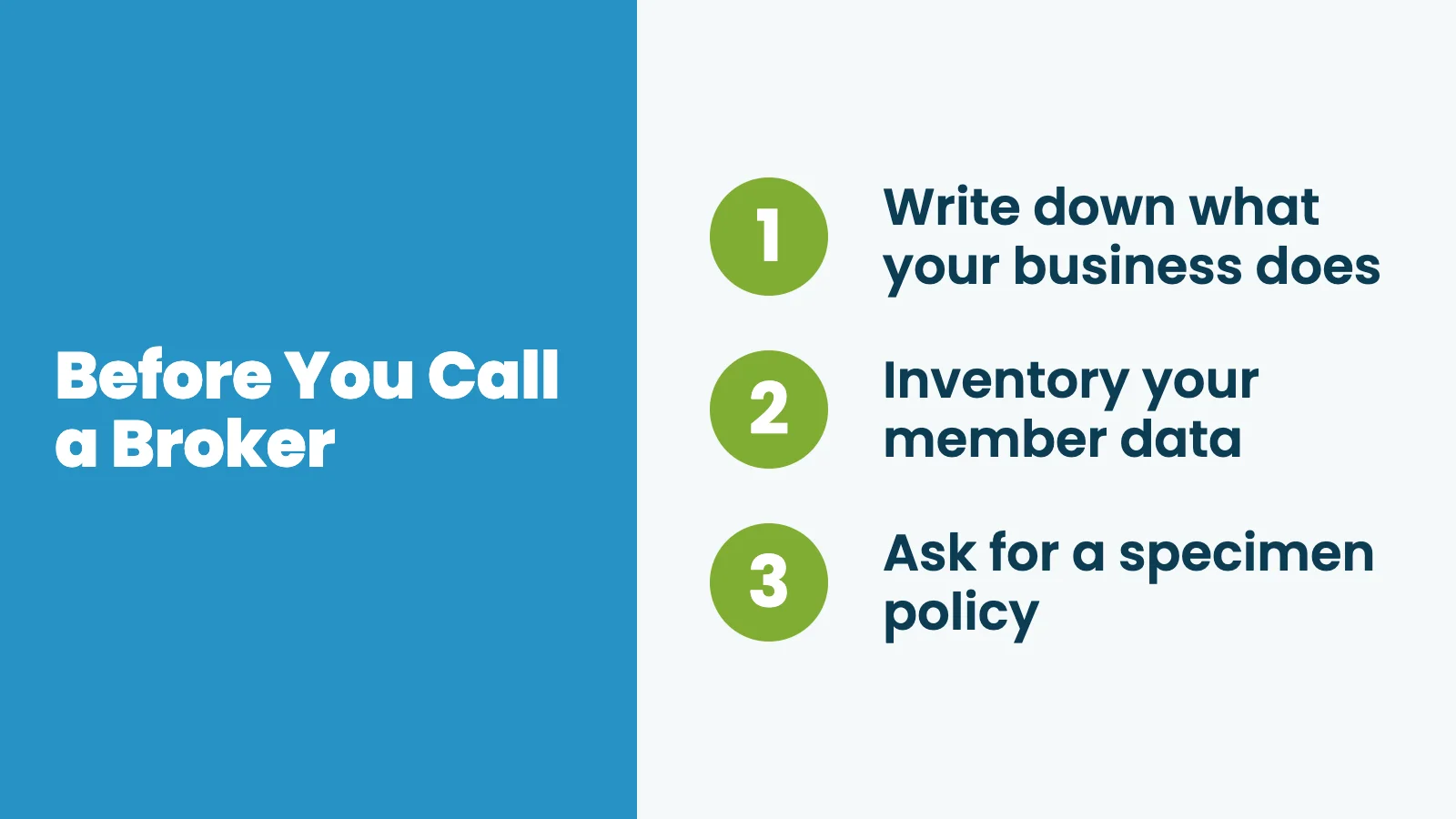
- Write down what your business does: One paragraph, in plain language. “I run an online membership for small business owners. Members pay monthly for two group coaching calls, a private community where I answer questions, and a library of templates and recorded workshops. I occasionally host in-person retreats.” That paragraph is what the policy needs to cover.
- Inventory your data: How many members, what you store, and which gateway handles payments. If you run Paid Memberships Pro, card numbers stay with Stripe or PayPal, and your site stores contact information and order history.
- Get your terms of service in order: A clear terms page with a disclaimer, a refund policy, and community rules reduces your risk and will come up on the insurance application. PMPro can require members to accept your terms at checkout before they can pay.
- Tighten site security: Turn on two-factor authentication for every admin account, confirm your backups actually restore, and audit who has access to the site. Cyber insurers ask about all three.
- Ask for a specimen policy, not only a quote: The quote tells you the price. The policy tells you what is covered. Read the professional services definition and the exclusions before you pay.
- Get at least one quote from a specialist: Coach and creator-focused carriers and brokers see this business model regularly, and the examples above show they often price it lower. A generalist who mostly insures restaurants will struggle to describe you to an underwriter.
Insurance is one piece of the legal setup for a membership business. If you have not done the rest yet, start with our guide to the legal requirements for a membership site.
Frequently Asked Questions
No law requires it for most online businesses. But if you sell advice or services, a single professional liability claim can cost more than your business earns in a year. Most coaches and consultants consider E&O the minimum.
Almost never. Personal policies exclude business activity, and a home office endorsement typically covers equipment, not liability for your work.
A BOP bundles general liability and property coverage. It does not include professional liability, cyber, or media coverage unless you add them. For a coach or publisher, a BOP alone leaves the biggest risks uncovered.
A claims-made policy only covers claims filed while the policy is active, for incidents after the retroactive date. If you cancel and someone sues over work you did last year, you are not covered unless you bought tail coverage. Keep these policies continuous.
Yes. Your site still stores member names, emails, addresses, and order history. A breach of that data triggers notification requirements in most US states and under GDPR. Read more about how GDPR affects sites running PMPro.
Publishing to 200 paying members is still publishing. Defamation and copyright claims do not care about the paywall. The exposure is smaller than a public site with the same content, but it is not zero.
Related Reading

Free Download: The AI-Powered Membership Site Blueprint
Download the free guide: Learn how to plan, build, and grow a membership site using AI as your strategic partner: from buyer persona to launch and beyond.